Pages

Sunday, April 14, 2013

Israel Highlights: Jerusalem & the Dead Sea Region

After leaving Galilee, we drove south along the Jordan River Valley and then turned West to ascend the hills into Jerusalem.  We approached Jerusalem as the sun was setting, stopped for dinner on the hills outside the city and then went to our hotel for the night.  The next three days we spent exploring Jerusalem, Bethlehem and the Dead Sea Region.  Below are the highlights (in my own opinion) of those three days.  The first day we walked the Old City of Jerusalem and I believed I gained more insight into not only Jesus' last days and ministry in Jerusalem, but also Jerusalem's history as a whole than I could've reading every book there is on Jerusalem.  There's just something about experiencing it, walking it, that makes it all come alive.  On our way back from Jordan as we were headed to Tel Aviv, we made one last stop over in Jerusalem for a few hours to visit the Hebrew Museum where we saw a model of Jerusalem during the Second Temple Era.  Jerusalem came alive to me.  It might still be a city full of sin with a strong religious spirit, but there's something special about those streets.  

Part 2 - Jerusalem & the surrounding region

Abraham's Tent
Climbing the Judean hills, we stopped for dinner at Abraham's Tent; a unique experience where we got to partake in a Bedouin dinner with Bedouin hospitality.  Much like how Abraham would have welcomed guests into his tent thousands of years ago.  The food was amazing - hummus, baba ganoush, fresh vegetables, olives, bread, date chicken with honey, meatballs, rice, bread, Turkish coffee and more bread.  We reclined on the floor and ate, and ate, and ate.  It was chilly out, as we were on a hilltop with the wind slipping in between the tent flaps, but the atmosphere was warm and inviting.  It was truly an unforgettable experience. 

Sunset View from Abraham's Tent
Bedouin Dinner at Abraham's Tent
Mount of Olives
Our first stop in Jerusalem the next morning was the Mount of Olives.  It is here that Jesus many times looked out over Jerusalem.  It is picturesque - and we all took advantage of the amazing backdrop.  I do wish we had spent more time here or maybe visited again after seeing Jerusalem more up close.  

The famous photo op
View of Jeruslame from the Mount of Olives, Jewish cemetery in the foreground 
This was not taken from the Mount of Olives, but actually from the Garden of Gethsemane.  It is the gate that Jesus entered into Jerusalem through on a donkey.  You can see that it is now covered up and blocked by Muslim graves.  The Arabs did this knowing that this gate had to do with the prophesy of how the Jewish Messiah would enter Jerusalem.  They believe by blocking and defiling it (making it unclean with dead bodies), that it will prevent the Messiah from entering Jerusalem...what do you think?
Garden of Gethsemane
Another favorite.  What is interesting about Jerusalem (more so than Galilee), is that every important site to Christians has a church built on it.  So what I expected to experience (an open hill, a garden of olive trees, etc) didn't happen.  Instead, everywhere we went there was a church or a holy site commemorating Christ built on top of it.  Some places, it was done well and beautiful, other places it was over the top with gaudy decorations and incense galore.  The Garden of Gethsemane was a beautiful church with not too much drawing away from the experience.  Supposedly the church is built onthe very rock upon which Jesus wept as he prayed in the garden the night of his arrest (and you can see it under the altar, even touch it).  How they know that...well, they don't really.  

Inside the church at the Garden
Old City
This part of the tour was really cool.  We actually walked the stations of the cross, but since I'm not Catholic and I really don't believe the Church of the Holy Sepulcher is the actual site of Jesus' death on the cross and burial, it wasn't a "spiritual" journey for me.  It was however, amazing to see the Old City streets and buildings all so close together.  Cars honking their horns to pass through crowds with store booths on either side and houses leaning into the street above.  There were many beautiful churches and the stations of the cross were clearly marked.  We walked all the way down the Via Dolorosa to the Church of the Holy Sepulcher, through the Muslim district where we had lunch, down into the Jewish quarter and out the Zion gate to the tomb of King David (and traditional site of the Upper Room) and then continued to the Davidson Center which is located near the excavation site of the Second Temple grounds.  It was a long day of walking - but so amazing to see Jerusalem up close.  We stopped at the Western Wall (the wailing wall) and had time to pray.  And then made our way back to where we started via the Kotel tunnels.  Tunnels under the Old City that run parallel to the Western Wall.  I feel like I am leaving out so much information, but for the sake of your attention span I hope you understand.  

Yes, cars use the same gates in and out of the Old City that the people do
Zion gate bearing the marks of the Six Day War in 1967 when Israel recaptured the Old City and unified Jerusalem
Walking the streets of the Old City
Western Wall
A celebration taking place at the Western Wall
Tunnels under the Old City
Church at the Pools of Bethesda
Just to the north of the Old City are the Pools of Bethesda, where Jesus healed a man born lame (John 5).  The Pools were covered up when Jerusalem was completely destroyed by the Romans in 135AD and rebuilt as a Roman city.  They have recently been rediscovered.  Close by the pools is a Crusader church (built by the Crusaders) and is a gorgeous building.  We got the opportunity to sing inside this church - it was an awesome experience.  

Crusader Church
Davidson Center
I didn't realize how much I would like this part of the tour, but learning more about what the Temple Mount looked like during the Second Temple Era (the time of Jesus) was fascinating to me.  The Davidson Center is near the southwestern corner of the old Temple Mount and areas which they have begun excavating.  Throughout the centuries since the Romans destroyed the city, Jerusalem has built upon again and again by other civilizations (Romans, Byzantines, Persians, Arabs, Crusaders, Ottomans).  As the Jews returned after Israel was declared a nation in 1948 (and after they regained the Old City in 1967), they have started excavating areas in Jerusalem going back to the Second Temple Era.  It was amazing to see the walls and walkways surrounding the Temple Mount dating back to Herod, the very roads Jesus walked on.

The remnants of the Temple Mount (southwest corner) 
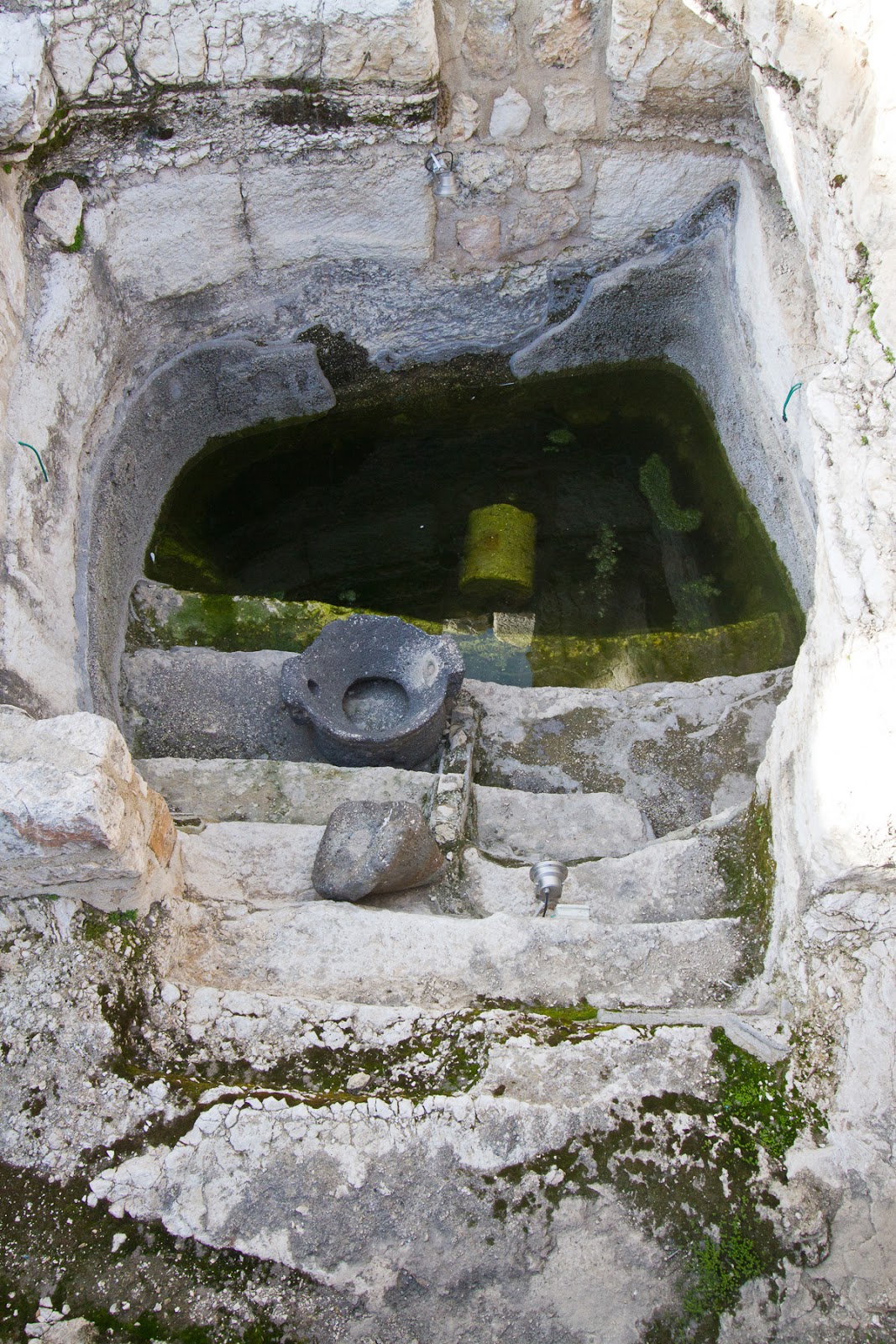
Uncovered Ritual Bath 
Before the excavations, Robinson's Arch (to the right) was underground.  The roadway below is from the time of Herod.  To the left (where the people are standing) are booths or stores where pilgrims could buy provision for their Temple visit.
Garden Tomb
In the 1800's a British general was looking out over Jerusalem and noticed a hill that had the appearance of a skull on the rock face.  After closer inspection, he also discovered a nearby winepress dating back to the first century and a tomb carved into the rock wall.  The British general was Gordon and the place he discovered he believed to be where Jesus died on the cross (Golgotha means "place of the skull") and buried (the tomb of Joseph of Arimathea was in a garden).  No one knows if this really is the place, but it may be or it may just look like it.  Out of all the places we visited in Jerusalem, the Garden Tomb felt the most real.  Probably because it didn't have all the incense, gaudy symbolism and other religious relics that adorn most holy sites in Jerusalem.  The organization which the runs the site were knowledgable and felt it wasn't the location that made it significant, but the truth that wherever the tomb of Christ was, the important face is that He is alive and no longer there.  Amen!  We shared communion there in the garden, overlooking the tomb.  What a sweet time of fellowship it was.

The cross on the wall has the letters for "Jesus Christ, Alpha & Omega".  It is a replica of an original cross found painted inside the tomb dating back to about 300AD. 
Communion 
"He is no longer here, He has risen!"
Yad Vashem Holocaust Museum
Beautifully done, the Yad Vashem Holocaust Museum was definitely a highlight.  The symbolism of the building structure itself was so interesting and meaningful.  Down the middle of the museum ran a main corridor that had "interruptions" or maybe better thought of as disruptions, major events during the War that impacted the Jewish community (such as railroad tracks, when they started shipping the Jews off to concentration camps).  On each side of the corridor were rooms and you zig-zag through the rooms between the interruptions.  Does that make sense?  The corridor was lit by natural light from skylights above - symbolic of the fact that much of what happened was in clear view to the world.  People knew what was happening in Europe to the Jews.  It was a sobering experience, and I can't describe it, it's just one of those things you need to do yourself.  In Israel I started reading Madeline Albright's memoir "Prague Winter" about her own family's plight and that of Czeckoslovakia during the War.  I am still reading it, but between those two experiences - the Museum and the book - it has piqued my interest about World War II.  

Masada
We took one day to head South from Jerusalem down to the Dead Sea Region.  Our first stop, after shopping for Dead Sea beauty products, was Masada.  A fortress built atop a large rock by Herod (another of his crazy creations).  I think it is rather an odd place to build a fortress, but I'm not a crazy Politician with lots of power and people at my disposal.  It is near Ein Gedi (a desert oasis where David hid from King Saul), providing fresh water nearby.  After Herod built his two palaces and gardens and such, years later when Jerusalem fell under siege to the Romans, a group of 1,000 Jews fled to Masada.  To their surprise they found the storehouses still full of food - preserved by the dry desert air.  The Jews built a synagogue, ritual bath and lived at Masada for 7 years holding off the Roman soldiers.  They had fresh water from an aqueduct system built by Herod and food to last them all.  When the Romans (you can still see their camps around the base of the fortress today) finally built a dirt and rock ramp up to the wall, the Jews, facing defeat, committed mass suicide.  Only a few survived (a few women and children).  To Jews today, they see this story as one of courage and Jewish pride - the Jews, unwilling to become slaves, thought death better than slavery.

Inside the remnants of the synagogue at Masada
At the top of Masada, looking down on one of Herod's palaces and looking out toward the Dead Sea
Roman bath built by Herod
The cable car off the mountain.  Do you see the square just to the left & up from the cable car?  That is a Roman camp.
Ein Gedi
Dead Sea
After Masada, we stopped at Ein Gedi and then onto Qum'ran where the Dead Sea Scrolls were discovered.  Our last stop was a float in the Dead Sea - what a cool experience.  I cannot explain it, but you really float.  In fact, it is hard to swim because you float so much.  I could literally float on my back, turn to my front and around to my back again without getting my hair wet.  So weird.  We helped ourselves to the abundance of squishy mud under our feet for mud baths.  It was a very fun way to end the day.

Mud baths in the Dead Sea

Thursday, April 4, 2013

Israel Highlights: Coastal Plains & Galilee

My mom & I starting our journey in the back of the bus
I have been trying to think of how to blog about my trip to Israel.  Since it's been over three weeks ago, it's probably time I put those thoughts into an actual post (side note: someone should totally invent a computer that reads my mind, it would really help in keeping this blog updated).  Overall, it was an amazing trip.  The land of Israel written about for thousands of years and containing history that is very important to my faith came alive as I rode with 50 others through the hills and valleys, dessert and plains.  For the first time I realized the value of having a tour guide.  Our guide was an Israeli who had an incredible understanding of history.  It was overwhelming the amount of history I learned!  Every night when we returned to the hotel, I had to brain dump in order to actually process the information.  Being with my mom was awesome and the fellowship of the tour group was better than I could've ever hoped for.  It was truly a blessing - something I was praying about.  

We started in Tel Aviv and headed north along the coast to Caesarea and then inland, stopping at Mt. Carmel before heading to the Sea of Galilee.  While in Galilee, we explored from Tel Dan in the north to Bet She'an in the south and all along the coast of the inland sea.  On our way to Jerusalem, we drove through the hills seeing modern day shepherds herding sheep and goats (always gaining our full interest and meriting hundreds of blurry pictures).  As we ascended the hills into Jerusalem, we stopped for dinner at Abraham's tent, a Bedouin hospitality experience complete with hummus, baba ganoush, date chicken, Turkish coffee and all the bread you could ever eat.  We conquered the old city of Jerusalem and learned more history in one day than I think I ever learned in one semester of school.  Bethlehem, the Holocaust Museum, Dead Sea, Masada - we saw them all.  Crossing the Jordan, we admired the same view God showed Moses thousands of years ago of the promised land, (this time with just a bit more haze and pollution) before heading south to experience the ancient city of Petra.  The Jordan called to us again on our way back over to Israel as we stopped at the traditional site where Jesus was baptized.  We finished our tour driving through the Elah valley, where David slew Goliath and then heading back to the shore of the Mediterranean, and the airport that would fly us home.  Nine days of non-stop sight seeing, history lessons, fellowship and experiences of a lifetime.  

So, how do you wrap that up?  Well, I don't think I can do it in one blog post.  But maybe, just maybe, I can attempt to do it in three.  Here we go...come and join us. 

Part 1 - Coastal Plains & Galilee

I'm probably not supposed to lump those two locations together.  Really, they are totally different geographically and have different climates.  However, in my mind they got lumped together somehow, so lumped they will remain.  Instead of walking you through a day-by-day, I'll just share my favorites and what struck me most.  Sound good?  

Caesarea
Our first stop and a place you could spend all day exploring.  Imagined and built by Herod, Caesarea was the capital of Judea and the site of the trial of Paul before he was sent to Rome.  Herod built an amazing palace, a deep sea port and other landmarks you would expect to see in a Roman or Greek city (not necessarily in Judea).  It was destroyed by the Arabs in the 600s and just recently has been excavated for tourists to imagine the city as it once was.  

The remains of Herod's palace extending out into the Sea.  The square in the middle?  A freshwater pool. 
Roman theater at Caesarea
Mom & I at Caesarea
Mt Carmel
This is where Elijah called on God and slew the prophets of Baal (1 Kings 18).  We gazed out at a sweeping view of the Jezreel Valley and imagined as we read from 1 Kings the show down between Elijah and the prophets of Baal.  The weather even cooperated, with dark looming clouds rolling in  from the sea and the wind picking up - driving home the scene Elijah must have experienced as he prayed for rain.  After our stop, we had lunch in a nearby Druze village and, yes, I had falafel and it was amazing. :-)

View of Jezreel Valley from on top Mount Carmel
Chapel on Mount Carmel
Sea of Galilee
What an amazing place.  We stayed two nights in Galilee and explored a lot of the surrounding areas.  My favorite though was getting to take a boat out on the lake to worship.  I had a minor panic attack as we were boarding because my camera stopped focusing (a problem we've had before), but I prayed over it (yes, I did), changed the lens and, PTL, it worked again.  Getting the opportunity to praise God out on the waves was a really unique experience.  After walking along the lake shore and then sitting in the boat looking out at the shore and surrounding hills, one can imagine Jesus walking the shoreline, calling to Peter, calming the storm...Galilee is a special place. 

Mount of Beatitudes from the Sea
Praise and worship on the Sea
Amazing sunset as we head back to the dock
Tel Dan
North of Galilee, near the Lebanon border is Tel Dan - the ancient city of Dan.  It dates back to the Middle Bronze Era (2000 BC, time of Abraham).  Today, the excavated remains around the city gates date back to the time of Elijah.  Historically, it was awesome to see such an old city with so many years of civilization that is now lying in ruin.  The Jordan River starts near Dan and Jor-dan literally means to "come down from Dan." 

Northern city gate recently excavated dating back to 2,000 BC 
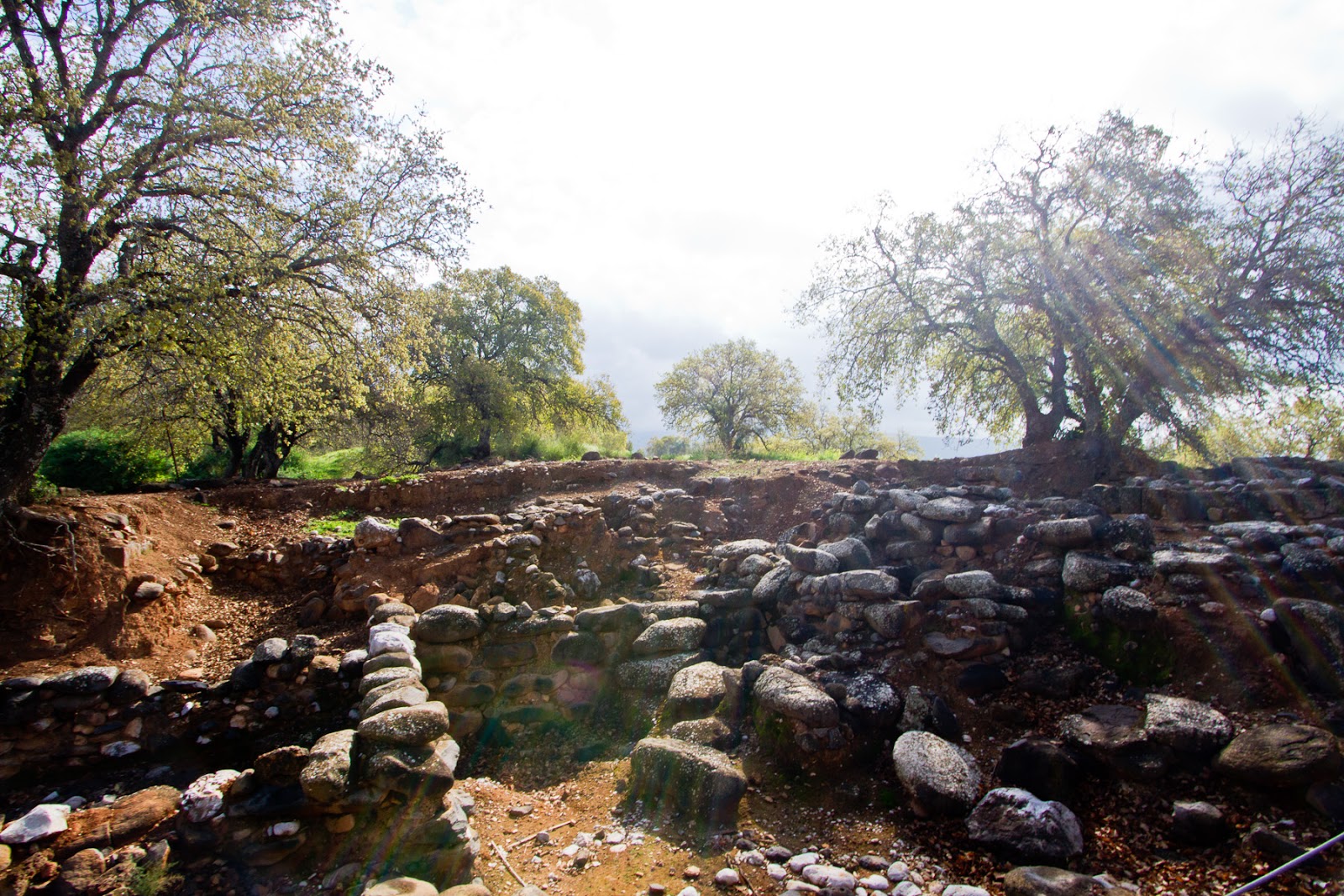
Ruins of Tel Dan
Mount of Beatitudes
I have always wondered how Jesus spoke to groups of thousands of people.  How is that possible?  Well, now I know!  After seeing the Mount of Beatitudes and looking down into the natural amphitheater that Jesus preached from (now full of banana trees), you can see how the hillsides collide to form a protected area where one's voice could carry very far.  I felt the same way on the shore of the Sea of Galilee - when the wind and water are still (early morning), one can easily call out to nearby boats or stand in a boat and call to those on the shore.  Another interesting cultural insight - when the people came and heard Jesus preach at the Sermon on the Mount (Mount of Beatitudes), they weren't thinking "this is the Messiah" but rather "this must be Moses" as he preached with wisdom and authority on the law.  A scene that must've reminded them of when Moses first gave the law to the Israelites from Mount Sinai.  Which would be why when Jesus asked his disciples, "who do people say I am?" That they answered, "some say Moses...".

Just imagine that each of those banana trees are a person
Bet She'an
Another amazing site with a lot of history.  The Tel in the back of the photos (a Tel is an artificial hill that is made from one civilization building on another) is the original city of Bet She'an where, in 1 Samuel 31, the bodies of King Saul and his son Jonathan were hung after their defeat by the Philistines at Mount Gilboa.  During the Greco-Roman period, the city was known as Scythopolis and was part of the Decapolis (10 major cities during the Roman rule).  During the 8th century, the city was destroyed by a large earthquake.  It is one of Israel's most prominent archaeological sites. 

The main colonnade at Bet She'an with the Tel in the background
Also in Galilee we visited Nazareth (a recreated village), Tabgha (miracle of feeding the 5,000), Caesarea Phillipi (city Jesus visited with his disciples, Matthew 16:13-23 & Mark 8:27), Capernaum, Gideon's Spring, and Tel Megiddo (the ancient city & site along the Jezreel Valley where Armageddon is prophesied to take place).

At Tel Megiddo, looking out to the Jezreel Valley

Saturday, March 2, 2013

Pre Holy Land Thoughts

Photo courtesy of wikipedia.com
Last night, I went with my friend to get my hair cut (finally).  So thankful that she came with me because my hair actually turned out pretty close to what I wanted.  Yay!  Today while you read this, I will have just taken the train into Shanghai to stay the night with some friends so I can catch my 10am flight on Sunday to Israel!  Back in the fall, my parents' church (and the church we attended in Richland) started recruiting for a trip to Israel to tour the Holy Land.  My mom wanted to go, but my dad wasn't able to, so they paid for me to go with my mom.  It's a double blessing because not only do I get to see the places Jesus walked and taught, but I get to see my mom.  So fun.

I'm almost ready to go, bags almost packed, but one thing I wish I had done more of was read and watch movies or documentaries about the places I will visit.  I know I'll learn a lot, but I just feel not as well prepared as I could've been, you know?  Anyways, here are some of my "Pre Holy Land" thoughts... 

1. I hope I am able to take it all in.  We travel a lot, but I feel like this trip is a once-in-a-lifetime event.  I get nervous thinking about that because I keep thinking, "what if I can't take it all in?"  I have no idea what that really means, but I'm anxious to experience it all. 

2. Warm weather.  I'm excited for 70F weather.  It got cold again this week.  Brrr...

3. Food.  Besides seeing the amazing sights we will see, I'm so excited for the food.  I love Middle Eastern and Mediterranean food so I'm pretty sure I'm going to eat until I get sick every night.  Haha.  Yay!

4. I'm not crazy about tour groups.  There's always one or two crazies who annoy everyone else.  I have a hard time ignoring those people.  But - I'm hopeful I can just stick by my mom's side and her friends from church and not have to get carried up in any drama.  We have over 40 people in our tour group, I'm pretty sure there's going to be some drama. 

5. And lastly, I keep thinking "how do I prepare my heart for this?"  Again, not sure how to answer that one, but lets just say that I keep praying and asking God to make me a learner of Israel.  To be aware of what's going on around me and to really experience the culture.  I want to walk away not just knowing more about the Biblical and historical sites, but more about the local culture and people who live there.  These are just places, holy places but still just places; it's the people who lived there (like Abraham, King David, Jesus & the Apostle Paul) and the people who live there now (both Israeli Jews and Palestinians) who God loves deeply.  I hope that I can see past the stones and replicas and into God's heart for that place.  

Friday, March 1, 2013

Thailand Recap

It feels like we got back from Thailand over a month ago, but it's really only been two weeks...hmmm.  I guess we've been busy!  Since I'm sure no one wants to read a full post about every aspect of Thailand I will just give you our favorite things from our trip which is much more fun, right?

We spent our time in the area in and around Pattaya.  Interesting area, full of European tourists (mostly Russian), lots of bars and is the "hotspot" of Thailand for the sex industry.  It was definitely eye opening and we weren't quite prepared for the amount of prostitution and bars we would see.  After about five nights of loud music and not sleeping, we changed hotels and went 20 km south.  It was a good move and we were still close enough to take advantage of the great restaurants and things to do in Pattaya, yet not be in the middle of all the crazy.  TripAdvisor became our new friend as we found all the below activities through that website.  Traveling soon?  I highly recommend checking out reviews of hotels and activities on TripAdvisor.

Koh Larn
Pattaya beach is crowded, noisy and not really the type of beach I want to spend my afternoon.  Too many people!  For $1, you can take a government boat 45 minutes offshore to an island called Koh Larn.  We heard there were better beaches there, so one morning at 7am we boarded the boat and headed over.  Once we landed, we rented a scooter and went to the southern tip of the island, a beach we saw on the map that looked "removed" from it all.  It was!  We got there around 8am or so and had the entire beach to ourselves until around 10am when all the other tourists started showing up.  Once the beach started filling up, we snorkeled for awhile and then took a break for lunch before heading back.  It was a great morning!  It took a lot to get away from the crowds, but totally worth.  And, while snorkeling, we found some great seashells.  Always a plus!

Making friends at the beach!
Finally, not a soul in sight!!
Million Years Stone Park and Crocodile Farm
Online we saw this "zoo" had decent reviews and was close to our hotel.  It claims to have the largest concentration of crocodiles in captivity - a pretty big claim!  So we hopped on our scooter to check it out.  It exceeded our expectations.  The zoo is built around a "stone forest" of petrified wood.  There is a random assortment of animals, some birds, camels, and horses.  The coolest part was the interaction with the animals.  The Hubby fed a crocodile a whole chicken on the end of a bamboo pole (exciting!) and I got to bottle feed a baby Bengal tiger.  So fun!

I'm pretty sure he didn't know I existed.  All he cared about was the bottle.
The Hubby getting to feed a crocodile.  Kind of crazy, yeah?
Nong Nooch Botanical Garden
Go ahead, let the name fool you.  Because it's not really a botanical garden, at least not what we picture when we think of botanical.  It was definitely a garden, just more Asian inspired than we were expecting.  The most natural spot was the "Palms of the World" exhibit which was basically a small park dotted with palms.  Throughout the park we were greeted by seas of animal statues - pandas, giraffes, tigers, sabertooth tigers (yes, I know).  They would line the path in between the different flowers and bushes.  So...different?  The best part was the elephant show.  They had two shows, a cultural show and an elephant show.  The cultural show was fun and well done, but the elephant show was amazing!  Did you know elephants can bowl?  They also play darts, soccer, can ride a bicycle, shoot a basketball and paint!  It was so fun.  Elephants are smart.  It was impressive.

Do you see the Stone Henge look-a-like to the far right?
See!  Elephants are talented. 
Khao Kheouw Open Zoo
By far our favorite.  We did this in conjunction with The Flight of Gibbon (below).  It was the most interactive zoo we have ever been to.  In parts of the zoo, the animals roam around freely (like deer and monkeys).  You could feed a rhinoceros (kind of scary), a giraffe and hang out with an orangutan.  They had the best exhibits I've seen in an Asian zoo.  Most Asian zoos are behind on the exhibit factor compared to zoos I've been to in the States.  We spent several hours there and should have rented a golf cart, but since we did Flight of the Gibbon first, we were already in the zoo and didn't want to walk back to the main gate.  Bad idea.  It was too much walking.  But we still had fun.

The Hubby's new friend, Cindy

Whatcha' got in there?
Flight of the Gibbon
Definitely a highlight.  It's a zip line tour through the rainforest and extremely fun.  I was nervous that I wouldn't feel safe.  I usually don't have a problem with heights, but I wasn't sure how secure I would feel hundreds of feet up in the air on small platforms.  The staff were incredibly safety conscience.  I felt very secure the whole time, and so, was able to enjoy myself.  The longest zip line was 300 meters - you couldn't see the end of the line!  It was pricey for Thailand, about $100/person, but was totally worth it.  As we zipped along, we saw gorgeous butterflies and amazing lizards.  I was hoping to see more wildlife, but I'm sure with people swinging through the trees yelling and laughing most animals tend to not hang out nearby.

Ready to go!
The "Honeymoon" Zip Line
Diving & Snorkeling
Also in Pattaya were several options for diving.  The Hubby is a certified diver (advanced, I think).  Anyways, we scoped out Pattaya Diving & Fishing which has the highest ratings on TripAdvisor and booked a day excursion with them.  We were the only ones booked through Pattaya Diving & Snorkeling, but on the boat there was another group of tourists who were with a different company getting their certification.  I do not dive, I snorkel.  So the Hubby did a couple dives and then around lunch we both went snorkeling.  It was fun to get out of town for the day and our dive guide was great. The waters in Thailand might not be as clear as Maui, but there were still some cool fish and coral to see.


Overall we had an amazing time and were blessed to get to take some time to relax and see some cool stuff.  We really felt like we hit the "reset button" and returned home to China refreshed and ready to get back to work.